Ironman St. George 2010 is in the books, but my feelings on it are still up for debate. As advertised it was a hard race and I (like most everyone) struggled. In the end I finished uninjured, KT was there to console me afterward, and I had a lot of fun - and I am thankful for that. This is more of a race recap, I'll dig into analysis in a later post where I'll dissect the data from the race.
I arrived in Utah on Wednesday, and it was windy. Crazy windy, like 25MPH sustained with 50MPH gusts. There would be no way to hold a bike race in that kind of weather, which had me worried. Thursday Rachel and I headed to Sand Hollow for a practice swim. I put on my brand new DeSoto T1 wetsuit (who says you can't swim in a brand new suit on race day) which replaced my old T1 that had started leaking water into the left arm. We pansied around ankle deep, afraid to dive into the cold water (we were told it was 57 degrees). Eventually I went in, and it was cold - real cold. I quickly developed an ice-cream headache, which I had never experienced in the water - despite having done some cold water swimming previously. I swam about half a mile (13 minutes) before hitting the shore again. Trying to get out of the water was disorienting. I was dizzy, and my eyes wouldn't focus. I thought it was my contacts acting up, but turns out your brain does crazy stuff when you stick it in ice water. I hobbled across the parking lot slowly, changed clothes, then turned on the car's heater. Wow, that felt good. I drove straight to the expo at Ironman Village and started shopping for a neoprene cap, which I unfortunately never found.
The night before the race was uneventful. KT and I made spaghetti for dinner, and made it to bed early since the alarm was set for 3:45AM. On race morning I got dressed, grabbed my bag and peanut butter bagel, and hopped on the bus.
It was cold at Sand Hollow, but by a miracle of the racing gods the wind had died down and would not be a factor. After pumping up my tires and putting my Accelerade bottles on the bike, I hid in the dressing tent for warmth. I kept my jacket and leg warmers on, and just tried to conserve body heat - I knew the lake was going to suck it right back out of me. There was nothing to do in the tent except stare at the other athletes. Nobody was talking, and to be honest it was kind of depressing. Half the guys looked like the wide-eyed soldiers about to land at Normandy in the opening scene of Saving Private Ryan, and the other half seemed calm and collected - almost enjoying spectating the first timers. Meanwhile, I was visualizing my race - though I didn't make it very far. In my head I imagined getting out of the water and stripping off my goggles, at which point it occurred to me that I didn't bring my goggles! A quick check of my bag confirmed it, and I had my first mini-panic attack of the week. I asked around a bit, and eventually two different athletes offered to loan me a pair. Thank you to racers #808 and #72, I tried to return the goggles to your bags at checkout but the officials there wouldn't allow it. One of the pairs I was loaned was a set of black tinted Aquasphere Kaiman goggles. This is exactly what I had planned on swimming in anyway! What a miracle. A quick adjustment, and they fit like they were molded for my face. With my pre-race drama completed, I wetsuited up and got in the queue for the beach.
On the way to the water I ran into my friend Alan, who was also racing. We wished each other well then disappeared into the crowd. I also was flagged down by
Pat who I hadn't seen in quite a while. Thanks for the encouragement. At 6:45 the pro field went off, marked by the firing of the start canon. I wasn't ready for the bang, and apparently was standing near the thing - and it scared the bejeesus out of me. A few minutes later they told us we were clear to enter the water, which I did. However, the announcer told us that we didn't
have to get in - and in fact said that you could stand on the shore if you wanted. What?! This beach is about 15 feet wide, and there are 2000 athletes. There is no orderly way for 2000 people to get through a 15 foot gap to start a race. At the other IM races I've done and witnessed, they force you into the water 10 minutes ahead of time, because it takes that long to get everyone in. I'm guessing they let it go due to the cold, but who knows. For me, I was relieved. The water was not nearly as biting cold as I remember from my practice swim. It was cold for sure, but I treaded water vigorously to warm myself up, and felt fine even when I got my head wet. I was secretly pretending that the water had actually warmed up, and not that it felt better due to the hundreds of bladders that had recently emptied into it. The crazy thing about everyone being on the shore still was that it wasn't crowded. I was near the front, yet it still didn't even feel like a large wave start - much less a huge mass start. I even spotted my friend
Ryan and wished him well - how do you recognize someone when you only see them from the neck up, and they're wearing a swimming cap and goggles just like every other person in the water? With about a minute before the canon, the other racers began streaming in, and then the race was on!
Like my previous IM swim start, I began swimming "heads up" style. This is slow, but it protects my face from being kicked until the crowd thins out. After a few hundred meters of being pummeled, things cleared up a bit. By the time I made it to the first turn, the crowd had thinned considerably - though I kept getting run into, punched, pushed, ankle-grabbed, and even had someone deliberately blocking me! Blocking. In an Ironman swim. In a lake. What a jerk. I thought he was just a bad swimmer, swerving because the sun was in our eyes. But after the fifth time he cut directly into my path forcing me to slow - it occurred to me he was actually trying to stop me from passing. Why? During our little encounter I'm sure 20 people passed us - it's a big lake. Eventually I windmilled over his back and got free and was back on my way. My take was that it was a very rude set of swimmers out there. We all know we're going to run into each other - if you don't get kicked in the face and/or groin during an IM swim then you're not doing it right, but I had way too many incidents that were not accidental. The other problem I had with the swim was the swim cap colors: orange for men, yellow for women. Nice, bright colors which are easy to spot in the water. But the buoys marking the course had also been picked to be bright and easy to spot in the water - they were yellow and orange. I kept spotting and looking for an orange buoy - but I often couldn't pick it out from the sea of orange swim caps in front of me. It didn't help that many people in the swim cheated, and swam to the left of the buoys! About half way through another problem came up, my wetsuit started leaking. I had water in my left arm - the same problem I had with my old wetsuit! I don't know why this is happening to me, but somehow water is leaking into the neck of my suit - even in my brand new T1! Other than making me cold, this slowed me down since water is pretty heavy and you don't want to drag it along with you. Add to all of this that the reservoir is primarily used for water skiing, which made it taste and smell like diesel fuel, and the swim was not something I want to do again.
I exited the water, my watch said 1 hour, 4 minutes which is actually a good swim. It was good to put all the BS behind me, and move on to the next stage without having lost any time. The wetsuit strippers ripped away my rubber skin, and I was off to the changing tent. I wasn't cold at all, so I decided not to wear my jacket. I did take my time in T1, used a towel to dry off, changed into biking shorts, and I even wore socks. I did make a mistake while dressing though - I put my race number on too early, before I pulled up my bib shorts. The race number got stuck underneath, though I didn't know it at the time. Later in the day on the bike I tried to get it out, but ended up ripping it - so my race number never really was displayed properly. After over 10 minutes, I was dry, dressed and out on the bike course.
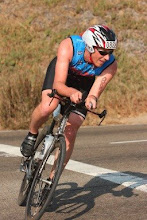
I settled in, the road out of Sand Hollow was newly paved and buttery smooth. I loved it. But, I kept my wattage low and watched as people flew past me. Stick to the race plan. At mile 10 I spotted my friend
Beth standing on the side of the road with a wheel in her hand. This was exactly what happened to Mary at IMAZ 2008, and I rode right past her without offering help - I feel horrible about it still. So I asked Beth if I could help, but her tubular tire had ripped - and she needed a new one, which I didn't have. So I continued on, hoping that this setback wouldn't end her day. Beth is crazyfast(TM) and I wasn't sure if it was worth it for her to continue if she lost a lot of time.
By mile 20 I felt tired. WTF?! Mile 20? I was going easy. Or more specifically, I was riding at a wattage that
should have been easy - but for some reason was not. I trekked on. At mile 40 my
coach Brendan passed me. We exchanged a quick update and some advice, but honestly I was just glad to see him. But surprised. Brendan is stupidfast(TM) and should have been WAY in front of me by now. I expected to beat him out of the water by a few minutes, but after my 10+ minute transition I assumed he had leapfrogged me there. All he said at the time was "I'm having a rough day also", but later I found out he was
downplaying it quite a bit. There were a number of cattle grates which had been covered with wood so we wouldn't fall in. However, they used 3/4" plywood, and hitting it direct could easy pinch-flat a tire. So I opted to bunny hop them. This worked out fine until I dropped a gatorade bottle on one of them. It was at mile 40, only 6 miles from an aid station - so it wasn't catastrophic, but it did throw off my hydration plan a little.
I made it up the two big climbs without issue, though I certainly wasn't looking forward to doing them again on the next loop. At the bottom of "The Wall" that leads up to Veyo there were 4 men who looked like the "Git'r Done" guy cheering us on. I think their cheering was genuine and not intended to be mocking, but it cracked me up. We had just started up the climb (maybe a mile of 12% grade?), and so we were downshifting and going pretty slow. I heard them yell things like:
"Is that all you got?"
"You didn't come all the way to Utah to ride like that, did you?"
"Go, go, go!!!"
"Get your ass up that hill!"
In the town of Veyo we made the right turn, and there were some people on bikes cheering us on. I recognized one of them as being
Coach KP whom I had met in November during the training camp, so I yelled hi at him. I'm certain he had no idea who I was! More importantly the right turn put us with a tailwind for the next 18 miles! I (and everyone else) flew through this section of the course. It took me 30 minutes to cover 14 miles, which is 27MPH! It was fun, especially in the spots where we hit 45MPH! I had never gone that fast in a race before, and the adrenaline revitalized me. I felt good for an hour or so.
But then I nearly got bike pee'd on, and my back started hurting causing me to sit up more. I really struggled to hit my wattage, and eventually I couldn't. I dropped another water bottle on the same cattle grate as the first loop. Additionally, the crazy fast stretch turned out to be much less windy the second time around - so no free ride back into town.
T2 was uneventful, my garmin 310xt picked up satellites before I made it out of the tent and so I was off and running pretty quickly. I walked the first aid station and got some gatorade down, then trucked off up Diagonal St. I felt OK, but when I saw the short steep climb on the small out-and-back, I decided to walk it as well. Then it was running again until the huge 8% climb on Red Hills Pkwy, which again I walked. By this time I was 4 miles in, and only 39 minutes had elapsed. Even with the long sustained uphill walks, I was managing 10min/mile - I was ecstatic! I flew down the other side of the hill ("flew" being a relative term, 8:20 pace), through the park and to the turnaround. I continued to walk the steeper hills and aid stations, picking up a gatorade at each one. By the time I made it to mile 12 I was tired, but chugging along. I spotted KT in the crowd and came over to say Hi. I told her "I think I'm going to die", but I was joking - probably shouldn't have tempted fate. Went down to the turnaround with a first half marathon time of about 2:10, which I was stoked about. I also spotted Beth's husband
James, who confirmed for me that Beth hadn't dropped out - and that she was about to run me down! She did so rather quickly, she had a fantastic race as far as I can tell. Anyway, just after the turnaround my stomach started acting funny. I stopped at the toilets and cleared things up a bit :) It was nice to just sit for a few minutes. However, when I got back on course I felt like vomiting. So I walked a bit, then tried again. Anything other than a walk resulted in extreme nausea. I feared I had taken in too much gatorade on the run, I had downed 13 cups by now. So I walked, and made it to the short steep hill on the out-and-back, which made me dizzy. Uh-oh, dizzy wile
walking? That's bad. I tried to run a couple of more times, but literally didn't make it more than a few steps before I had to go back to walking. I eventually conceded that I was done racing, and that the only way I would complete the race was to walk the remainder. It took me 4 hours to walk the second half of the marathon, giving me a time of over 6 hours for the run.
During those four hours, I was not a pleasant person. I was mad at myself, mad at the world, bitching and moaning to anyone unlucky enough to be near me. I trodded on, with the bottoms of my feet aching and some new (and quite extreme) knee pain kicking in. I watched the sun go down and lamented my inability to finish in the daylight. I watched my friends go by, and instead of cheering them on I whined about my shitty condition. I apologize to all of you, I would go back and handle it differently if I could. During the walk I met up with another racer who was in worse shape than me, and we walked and talked. I noticed my voice was a little weak, but figured it was just a little dry.
Eventually we made it to mile 25.5, and my new friend and I shuffled the last half mile together. I honestly don't even know my finish time, and I don't want to look it up. I know it was around 14:30, but it's unimportant to me. My "catcher" put a blanket around me, shuttled me to the pictures, then tried to get me into medical. I assured him I was fine, but he was persistent. I eventually got away from him, but didn't understand why he was so insistent on me getting to medical. I found out when I got home - my face was absolutely coated with white salt. Not good.
From the days that followed the race it became clear that I was really dehydrated, but I don't know how or why. I drank a lot out there. 140oz of fluid during the bike, and 13 cups of gatorade before I hit the wall. But it wasn't enough - apparently it wasn't even close. Was it the altitude? Dry air? Do I just need more than 20oz per hour? Did I not get enough salt?
After the race I quickly found KT, who was confused, then pissed, then relieved, then frustrated with me. I was just glad to see her. It had been a long day, and it meant the world to me that she was there to cheer me on. Plus, she's an excellent sherpa :)
I don't have any idea how my hydration on these races is still so messed, but I'm determined to figure it out before my next Ironman. I think I could have run a 4:40 marathon had hydration not put me into a fit of nauseous dizziness. I was feeling a little burned out on Ironman in the weeks leading up to this race - but having an unsatisfying result has fixed that problem. Which way to Wisconsin?



 Posts
Posts

